
INDUSTRY INSIGHT · ONCOLOGY
2026 CACA Southern Conference · In-Depth Report
What a Wuhan conference watched by 32 million reveals about how Chinese oncology will play the next five years
Industry News · Healthcare (In-Depth) · November 2026
In June, a three-day oncology conference in Wuhan seated some 3,000 attendees on site and drew a peak of 32.31 million concurrent online viewers. For any academic meeting, the number would be extraordinary — but in cancer care, a field that touches tens of millions of families, it reflects a collective public question: how far has cancer treatment actually come? Setting the agenda aside and reading the conference alongside the peer-reviewed studies behind each lecture, something larger emerges: a systemic turn in Chinese oncology.
On June 6, 2026, the Southern Conference on Integrative Oncology, hosted by the Chinese Anti-Cancer Association (CACA) and organized by Tongji Hospital and the Hubei Anti-Cancer Association, opened in Wuhan under the theme "Cancer Control Wins Through Integration." On its own, it was one main hall plus over 40 sub-sessions. In industry context, its position is telling: it was the second stop of CACA's new "4+1" format, under which the 2026 Chinese Congress on Integrative Oncology (CCHIO) is first split into four regional meetings — Chengdu, Wuhan, Hefei, Shijiazhuang — before converging at the national congress in Changsha. The baton in Wuhan has already passed to the Anhui hosts of the Eastern meeting. The intent behind this new calendar is plain: push high-quality academic resources downward. The point was underscored on site — twelve provincial cancer centers, including Sun Yat-sen University Cancer Center and Fudan University Shanghai Cancer Center, joined CACA in launching a "Grassroots Empowerment Program" for integrated cancer management targeting the "last mile" of care, while the first theatrical popular-science film on cancer prevention, Fengsheng: Facing Cancer, kicked off a rural screening campaign of more than 100,000 shows. In his opening address, Academician Fan Daiming framed CACA's three strategic pushes for the 15th Five-Year period: from domestic to international, from present to future, and from academia to culture.
Inside the main hall, six keynote lectures spanned the full chain from basic immunology to proton physics. Read together, they sketch a picture: cancer therapy is decisively shifting from the monotherapy era into the combination era, from empirical medicine toward subtype-driven treatment — and Chinese teams have moved from following the global agenda to setting it in several fields, this time with top-journal citations behind every claim.
01 Cold and Hot: A Decade-Old Puzzle, Taken Apart
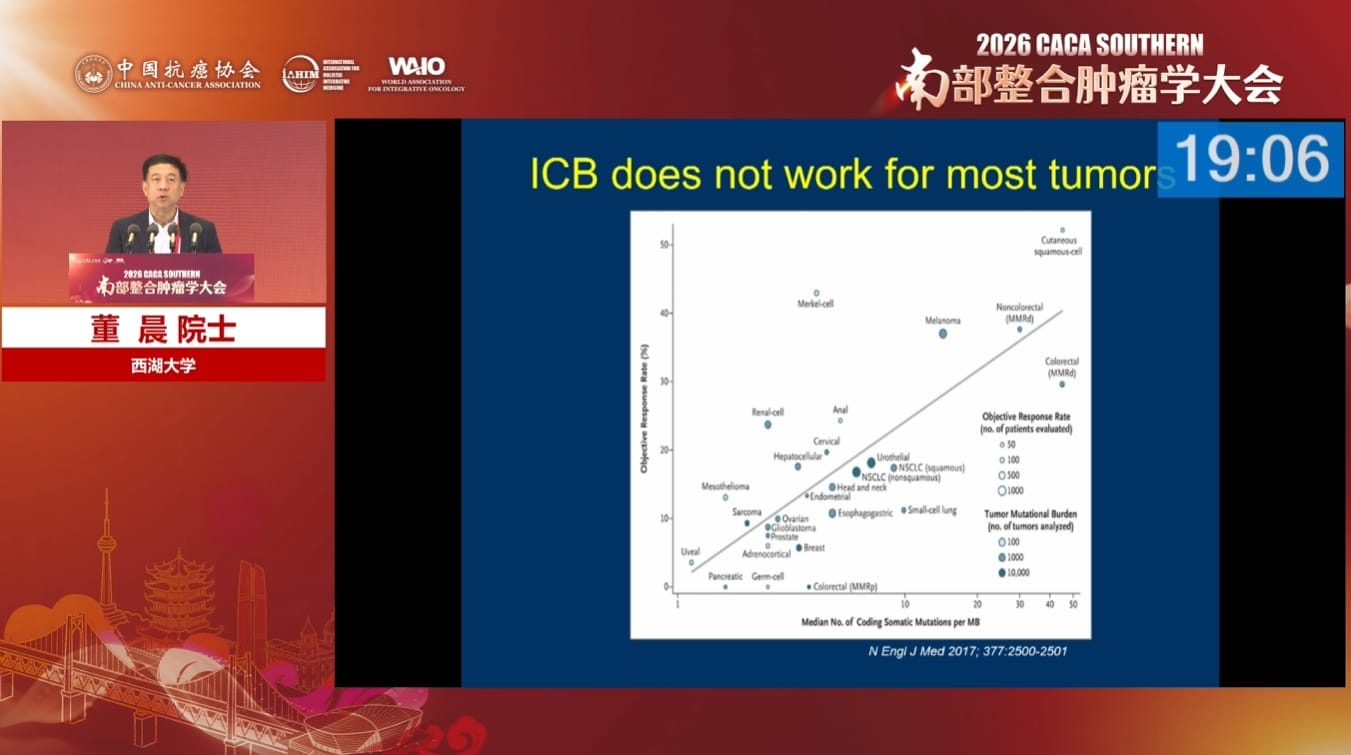
Immune checkpoint blockade (ICB) has been the defining breakthrough in oncology over the past decade, earning its discoverers the 2018 Nobel Prize. Yet clinical reality remains awkward: PD-1 monotherapy benefits only about 10–15% of patients in most tumor types. Why? The answer lies in the "black box" of the tumor microenvironment.
A 34-Patient Liver Cancer Study Identified Different T-Cell Responses
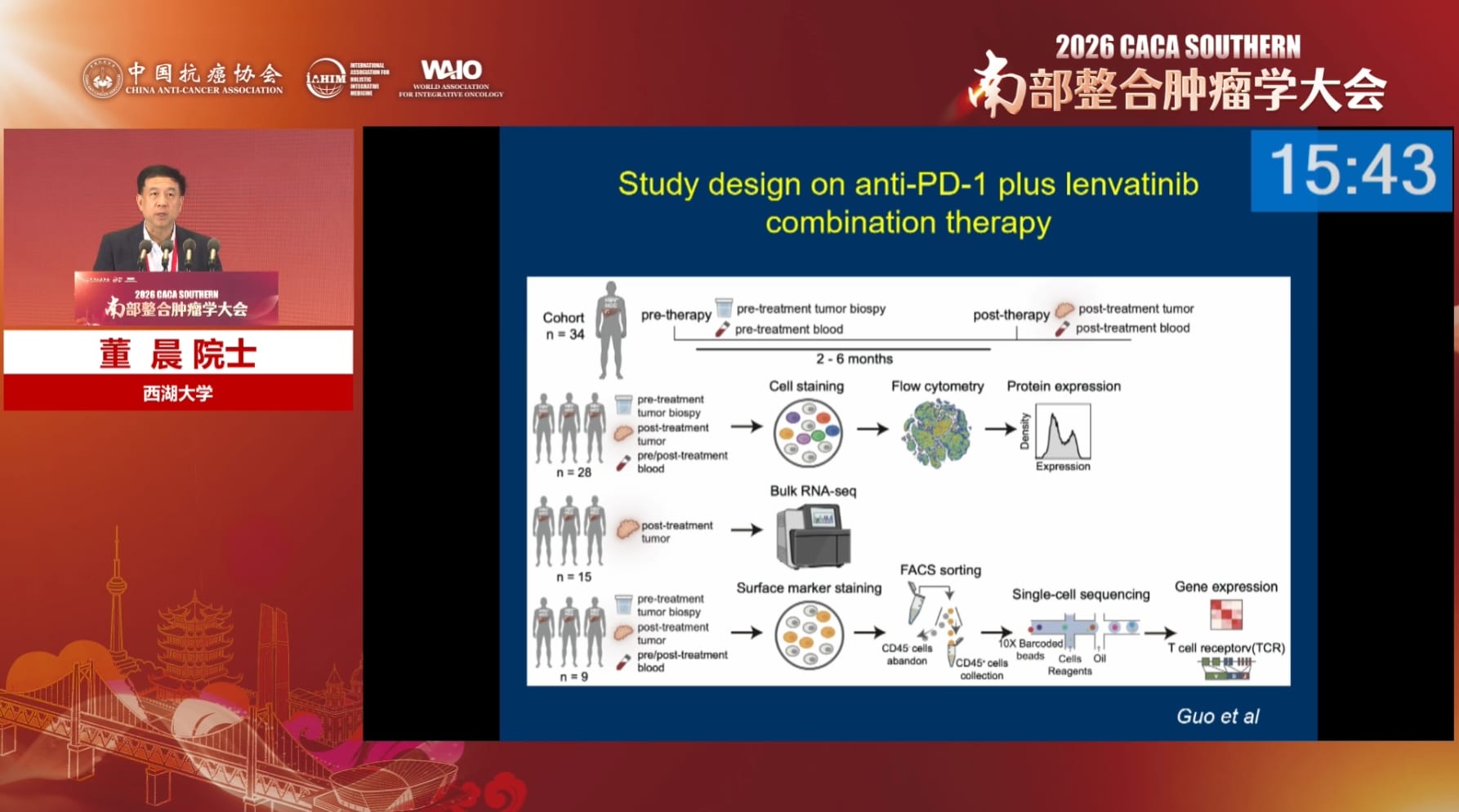
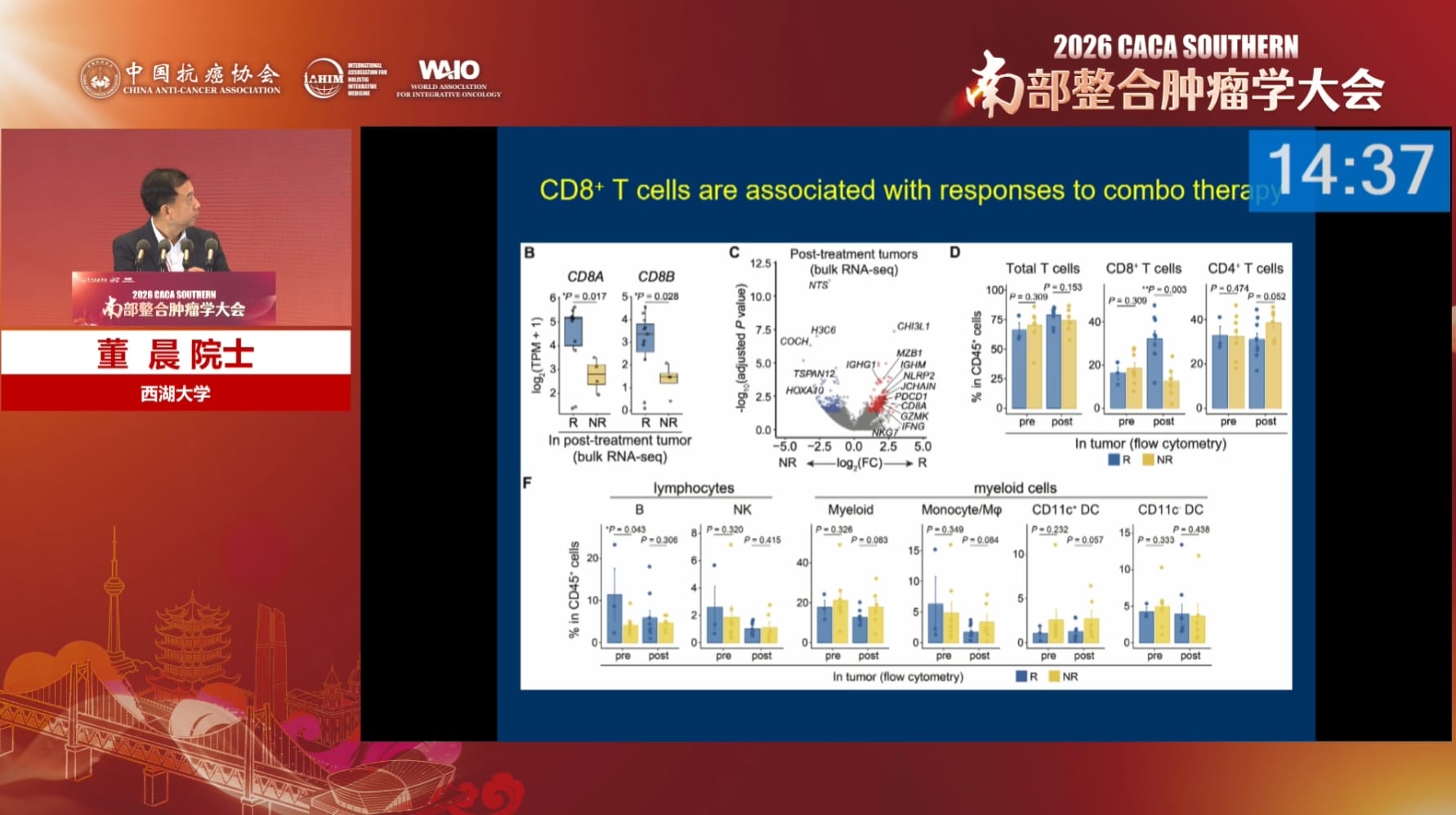
At the conference, Academician Dong Chen of Westlake University took that box apart in a lecture titled "Progress and Prospects of Cancer Immunotherapy." The underlying study, published in Cancer Cell in February 2025 (impact factor 48.8) by Dong's team with Lu Shichun's group at the Chinese PLA General Hospital and Zhang Lei's group at Shenzhen Bay Laboratory, enrolled 34 liver cancer patients receiving PD-1 plus lenvatinib, collecting paired blood and tumor tissue before and after treatment and tracking immune dynamics with flow cytometry, RNA sequencing, and single-cell sequencing. Two cell populations pointed in opposite directions. In responders, the expanding population was a circulating effector memory T cell subset — named cTem by the team — which expanded only under the combination, not with PD-1 alone, explaining at the cellular level why liver cancer "failed on monotherapy but succeeded with combination." In non-responders, the expanding population was a suppressive KIR+CD8+ regulatory T cell — first described in humans in Science in 2022, and now linked for the first time to worse outcomes under real-world combination therapy. Some patients deteriorate not because the drug is too weak, but because their bodies activate a counter-mechanism.
"Since we've identified the mechanism, the next step is to develop blocking strategies against it, and convert that 50% of non-responders."
— Dong Chen, keynote lecture, 2026 CACA Southern Conference
Ms4a7 and the Biology of Tumor Antigen Presentation
The same logic advanced another step in Science on November 13, 2025. This time Dong's team turned from T cells to their upstream "sentinels" — type 1 conventional dendritic cells (cDC1s) — and identified Ms4a7 as the molecule deciding their cross-presentation capacity. The protein is upregulated in cDC1s after antigen uptake, regulated by NF-κB signaling, and governs the final step of handing tumor antigen to CD8+ T cells: without it, the sentinel still swallows and degrades tumor debris but cannot wake the killing force. More translationally, across multiple human cancers, MS4A7 expression in the cDC1 compartment correlates positively with patient survival. From mechanism to prognostic biomarker to candidate drug target, the first stretch of a translational chain has been drawn.
02 GI Cancers: From 10% to 44%, the Chinese Regimen's Triple Jump
If Dong answered "why," Academician Xu Ruihua of Sun Yat-sen University Cancer Center answered "how" in his lecture "GI Immunotherapy: From Clinic to Bench" — with numbers published in top journals.
Using TMB and POLE/POLD1 to Identify Potential Responders
Gastrointestinal cancers are the graveyard of immunotherapy, with monotherapy response rates of just 10–15%. Over more than a decade, Xu's team has pursued two themes: identifying who truly benefits, and reshaping the immune microenvironment. On the first, the team was the first worldwide to show that tumor mutational burden (TMB) predicts benefit from immunotherapy in gastric cancer — a finding later validated and converted into an approved indication — and the first to identify POLE/POLD1 mutations as predictors, now written into guidelines at home and abroad. On the second, one counterintuitive discovery stands out: not all chemotherapy "activates" immunity — paclitaxel proved more immunostimulatory than the Western standard 5-FU, and the "Chinese regimen" built on this doubled long-term survival in esophageal cancer; a triple combination of an HDAC inhibitor, an anti-angiogenic agent, and PD-1 raised response rates from roughly 2% to 44% in clinical trials, with a Phase III study now complete.
MSI-H Colorectal Cancer and Neoadjuvant Immunotherapy
The most striking figure came from MSI-H colorectal cancer. On October 2, 2025, Cancer Cell published the Neoshot IB study (NCT05890742), led by Xu's team, as its cover article: in locally advanced MSI-H/dMMR colon cancer treated neoadjuvantly with a CTLA-4 plus PD-1 dual-immunotherapy regimen — both drugs (IBI310 and sintilimab) developed in China — pathologic complete response reached 78.4%, with no recurrence at a median follow-up of 21.4 months. In plain terms, nearly eight in ten patients had no cancer cells left in the surgical specimen; surgery was performed in 51 of the 52 patients assigned to the combination arm. It is the world's first dual-immunotherapy neoadjuvant regimen validated by high-level evidence — the first complete chain of proof for the "immunity-for-organ" treatment philosophy. Xu also pointed to the next frontier: gut microbiome and AI-driven target discovery. "The traditional model of drug development, driven by targets and literature, is too narrow. AI is a new paradigm. Whoever masters AI holds the future."
03 Lung Cancer: Bispecifics and ADCs, Two Arenas of Chinese Strength
"Lung cancer is not one disease," opened Prof. Zhou Caicun of Shanghai East Hospital in his lecture "Precision Medicine in Lung Cancer: A New Era" — a blunt statement that is now oncology consensus: by driver genes alone, lung cancer splits into at least a dozen distinct diseases demanding entirely different strategies.
PD-1/VEGF Bispecific Antibodies: Ivonescimab Clinical Data
His lecture mapped two arenas worth watching. The first is bispecific antibodies. In the HARMONi-2 trial (published in The Lancet in March 2025), the PD-1/VEGF bispecific ivonescimab extended progression-free survival to 11.14 months versus 5.82 months for pembrolizumab — a 49% reduction in the risk of progression or death, and the first time any drug had beaten the immunotherapy "gold standard" in a head-to-head Phase III. Then, three months after the conference, at the September 2026 World Conference on Lung Cancer, the trial's interim overall survival analysis landed: median OS of 30.8 months versus 22.6, a 27% reduction in the risk of death, and a three-year survival rate of 45% — upgrading "beating Keytruda" from a PFS victory to the hardest endpoint in oncology. The second arena is antibody-drug conjugates (ADCs): a Phase III of a TROP2 ADC plus PD-1 in first-line treatment showed one-year PFS of 62% versus 29%. What impressed experts most was the shape of the survival curve: "The tail of the curve is a straight line — meaning more patients are heading toward clinical cure."
China-Developed Oncology Biologics and Global Licensing
Notably, the molecules leading both arenas are largely of Chinese origin. Zhou noted that in just the first months of this year, out-licensing deals for Chinese bispecifics exceeded USD 60 billion — capital voting with real money on Chinese innovation.
04 A Pancreatic Cancer Vaccine and the "Cruise Missile" of Radiotherapy
Microsphere Technology Designed to Simplify Vaccine Delivery
Immunotherapy has rewritten outcomes in melanoma and other cancers, but pancreatic cancer — the deadliest — has remained nearly untreatable. In "Clinical Studies of Personalized Nanovaccines in GI Cancers," Prof. Nie Yongzhan of Xijing Hospital presented a new path: personalized nanovaccines. Developed with the Chinese Academy of Sciences, a polylactic acid microsphere adjuvant using a "thermo-adsorption" loading strategy dramatically simplifies manufacturing — antigen utilization improved more than 7-fold, injections cut from roughly 10 to 5–6 doses. In an investigator-initiated study, among 13 patients who completed prospective follow-up, none saw tumor recurrence, while existing metastases shrank or disappeared; the platform has shown favorable safety and antitumor activity in advanced pancreatic and gastric cancer. The work holds China's first clinical approval for an original particulate vaccine, with a multicenter study starting in 2026.
A Phase III Oropharyngeal Cancer Trial Reported Higher Five-Year Survival
Radiotherapy is undergoing its own quiet revolution. The pivotal data cited by Prof. Yuan Xianglin of Tongji Hospital in "Proton Therapy: Status and Progress" came from a Phase III trial led by MD Anderson Cancer Center, published online in The Lancet on December 11, 2025: 440 patients with stage III–IV oropharyngeal cancer were randomized to proton (IMPT) or photon (IMRT) radiotherapy. Progression-free survival was comparable — but overall survival diverged: 90.9% versus 81.0% at five years, with significantly less dysphagia, dry mouth, and feeding-tube dependence. It is the first Level 1 evidence demonstrating a survival benefit for proton therapy — within a non-inferiority framework, protons did not merely match photon therapy; they beat it. "Radiotherapy is at a critical turning point," as Memorial Sloan Kettering radiation oncologists wrote in an accompanying commentary: when healthy organs are spared, patients tolerate treatment better — and may live longer.
"Toxicity reduction is not the endpoint of proton therapy — it is the bridge to survival benefit."
— Yuan Xianglin, Director, Cancer Center, Tongji Hospital
Imaging-Guided Verification at Tongji Hospital
The line may prove the best footnote to proton therapy's rise in China. The country now has 18 proton centers in clinical operation, the fastest growth worldwide. Yuan's own center has, using a 2-meter axial-FOV PET-CT, become the first in the world to verify proton dose delivery in vivo, with more than 500 patients treated. At the conference, Yuan also presented Central China's first innovative prostate cancer case: an absorbable hydrogel spacer implanted between prostate and rectum to shield the rectum, paired with PSMA PET/MR-guided target definition and five-day-per-week hypofractionated proton therapy — no rectal injury throughout treatment, all follow-up metrics normal. Radiotherapy's "physics-driven" era is merging into a "biology-guided" one.
05 Integration: The Real Keyword of the Conference
Six lectures spanning immunology, GI oncology, lung cancer, vaccines, and radiotherapy may look scattered, but they converge on one direction: cancer care is leaving behind the era of "one weapon for everything." The integrative oncology philosophy championed by Academician Fan Daiming — fighting cancer, controlling tumors, and supporting life with equal force — was echoed concretely in the science: immunotherapy needs the synergy of chemotherapy, anti-angiogenics, and bispecifics; radiotherapy needs AI and biological imaging; surgery must be paired with rehabilitation and whole-course management. A humanistic thread ran alongside: Academician Chen Xiaoping of Tongji Hospital devoted his lecture, "How to Be a Good Doctor," to fifty years of lessons in character, craft, and scholarship — a one-hour reminder, amid wall-to-wall technology, that the other end of integration is the patient. As Wei Shaozhong, president of the Hubei Anti-Cancer Association, put it in closing: "Technologies change by the day, but patient-centered care never changes. Integration is the trend, fusion is the key, and collaboration is the way forward."
Step back, and the conference reflects a shift in how Chinese oncology plays the game: in R&D, from follow-on innovation to original mechanisms and homegrown molecules; in evidence, from joining international multicenter trials to leading studies published in top journals; in system, pushing standards to the county level through the "4+1" calendar and grassroots empowerment; and in globalization, converting technology into revenue and influence through out-licensing. For the healthcare industry, the signal from Wuhan is unmistakable: biomarker-driven precision stratification, multi-mechanism combinations, bispecifics and ADCs, personalized vaccines, proton therapy, and AI — the competitive map of the next five years has already been drawn.
Sources and Original Research
Sources: Keynote presentations at the 2026 CACA Southern Conference on Integrative Oncology (Chinese Anti-Cancer Association, Wuhan, June 5–7, 2026); public reports by CACA, Science Net China, China Daily, and The Physician; and the underlying peer-reviewed studies: Cancer Cell (Feb 2025), Science (Nov 13, 2025), Cancer Cell cover article (Oct 2, 2025), The Lancet (Mar 2025; Dec 11, 2025).
- Chinese Anti-Cancer Association — 2026 Regional Conference Schedule
- Chinese Anti-Cancer Association — Official Southern Conference Report (June 8, 2026)
- Tongji Hospital — Conference Coverage and Proton Therapy Research (June 8, 2026)
- Science — Ms4a7 Expression in cDC1s and Antitumor Immunity (2025)
- The Lancet — Proton vs Photon Radiotherapy for Oropharyngeal Cancer (2025/2026)
- Cancer Cell — PD-1 plus lenvatinib T-cell study, Chen Dong et al. (2025)
- Cancer Cell — Neoshot IB: IBI310 plus sintilimab in MSI-H/dMMR colon cancer (2025)
- IASLC — HARMONi-2 overall survival analysis, WCLC September 2026
Research verification: Neoshot IB documented pathological complete responses after surgery, not demonstrated surgery avoidance. In the combination arm, 51 of 52 participants underwent surgery. The corresponding study was published online October 2, 2025. The Cancer Cell T-cell study calls the circulating effector-memory population “cTem.”
Disclaimer: This article is an industry news summary. All data and conclusions are paraphrased from publicly presented academic content and peer-reviewed publications, and are intended for professional reference only. It does not constitute medical advice, prescribing guidance, or any claim of therapeutic benefit.